

Is Wine Healthy for You?
When my book club gathers each month, at least one member typically says, “Gosh, I shouldn’t be drinking so much,” as she gleefully pours more wine into her empty glass. I am never sure if I should be amused or worried, not knowing if gleeful–or possibly excess–consumption happens daily or occasionally, such as at events like our book club gatherings. As a registered dietitian, I know people want to know the answer to the question: Is wine healthy for you? Yes, it is, but there are a few caveats to consider.

Concerns about excess alcohol intake are becoming more common as people look at habits that affect their health. Alcohol consumption is associated with both benefits and risks and various organizations have differing recommendations.
Wine Health Considerations
Organizations like the World Health Organization and the American Cancer Society take a very conservative approach and recommend avoiding alcohol due to increased risk of certain types of cancer including breast, colon, esophageal, and liver cancer.
The latest version of Dietary Guidelines for Americans however did not include a specific recommendation and instead stated, “Consume less alcohol for better overall health.”
The American Heart Association advises “moderate” consumption for people who choose to drink, which translates into no more than one drink equivalent per day for women and no more than two drinks per day as the equivalent for men.

The Centers for Disease Control and Prevention (CDC) provide the following definitions for drink equivalents.
One standard drink is equivalent to:
- 12 ounces of beer with 5% alcohol.
- 8 ounces of malt liquor with 7% alcohol.
- 5 ounces of wine with 12% alcohol.
- A shot or 1.5 ounces of liquor or distilled spirits (80-proof liquor).
- 80 proof means the liquor has 40% alcohol.
- Brandy, gin, rum, tequila, vodka, and whiskey are examples of types of liquor.

So… is Wine Healthy for You?
Okay, so back to the question of is wine a healthy choice for you? Or the more common question is red wine a better choice? Before you decide what to drink, consider if you should be drinking.
Here are factors to consider:
- Alcohol is never recommended for anyone who is pregnant.
- People taking prescription medications that are metabolized in the liver should not drink alcohol.
- Individuals at increased risk for certain types of cancer should avoid drinking alcohol.
- Anyone with a personal history of alcohol use disorder should not drink any alcohol.
- People with family members who struggle with alcohol use disorders need to be mindful about addictive behaviors related to alcohol use.
- Anyone whose doctor has advised against alcohol consumption should follow their doctor’s advice.

If you are confident that moderate alcohol consumption is a good choice for you given your family and medical history and are wondering if wine is a healthy choice, read on. The alcohol in wine reduces the stickiness of platelets in our blood, and the phenolic compounds in both red and white wines may provide anti-inflammatory and antioxidant benefits.
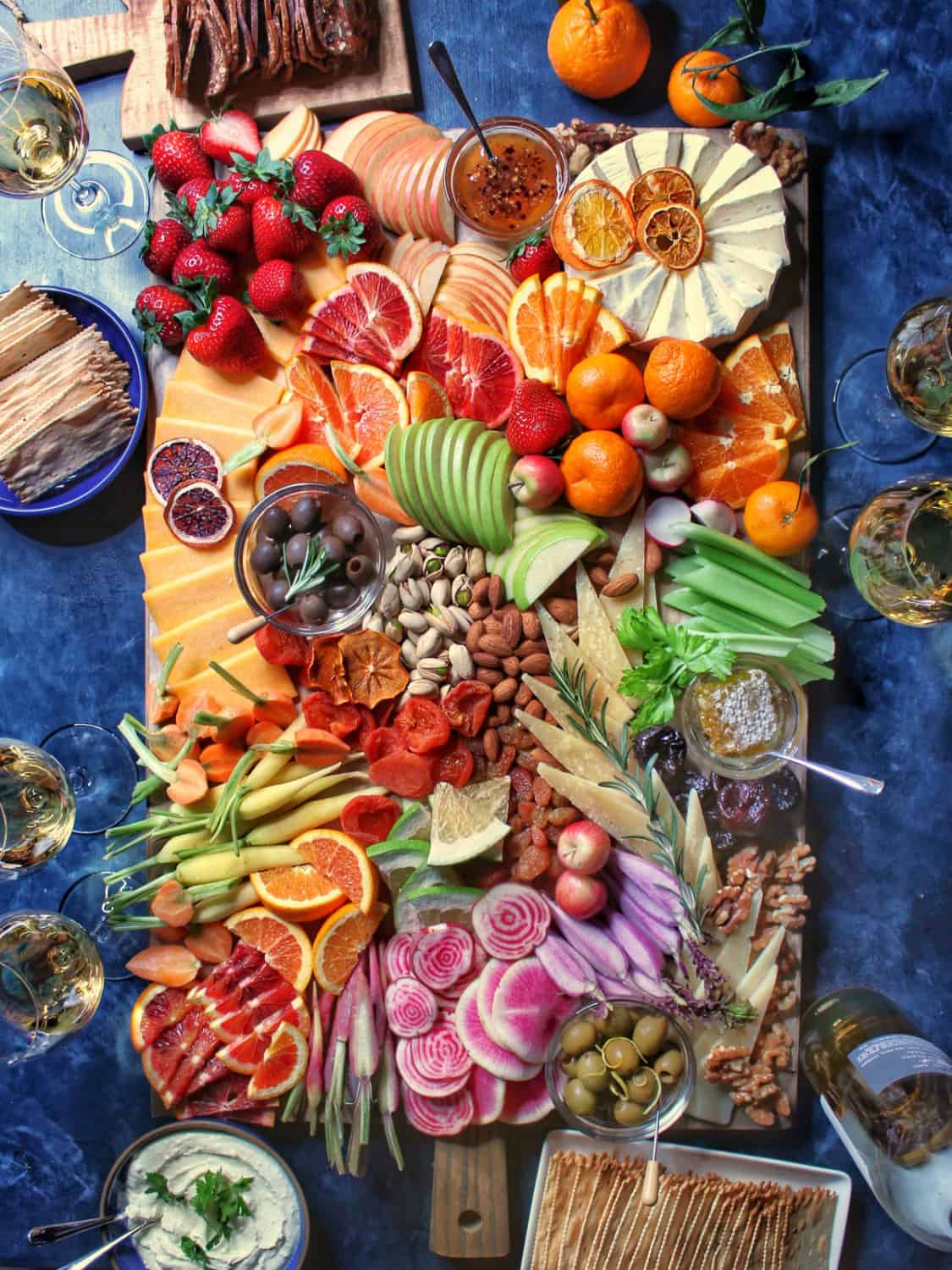
But perhaps the most important benefit of a glass of wine is time spent with people you love, talking, laughing, and enjoying each other’s company along with great food featuring California Grown ingredients!
This healthy cheese board from The Delicious Life is a party perfect pairing for your favorite California wine.
Nutrition Facts About California Wine
A common concern related to wine and nutrition is caloric content. Here is what you should know:
- Most of the calories in any type of California wine come from alcohol; calorie content varies depending on the alcohol content.
- Most California wines contain very little to no carbohydrates, just 1-4 grams per 5 oz. glass.
- One 5-oz. glass of California wine contains approximately 120 calories.
- California sparkling wines may contain 1-6 grams of carbohydrate or residual sugar from the grapes per 5 oz. serving. Brut sparkling wines will have the least residual sugar while Demi-Sec and Doux wines will taste the sweetest and have the most residual sugar.
- One 5-oz. glass of California sparkling wine contains approximately 100 calories.
- California Sweet wines like Sauternes and Port are higher in sugar and alcohol compared to table wines and sparkling wines.
- California dessert wines or sweet wines like Sauternes and Port contain approximately 100 calories per 2 oz. pour.
- Research supports the role of moderate wine consumption in promoting cardiovascular health, likely due to the anti-inflammatory, antioxidant, and antiplatelet properties of phenolic compounds in wine.

Want To Learn More About California Wines? Check Out These Articles Next





Need a New Music Pairing for Your Next Glass of California Wine? Check Out This CA GROWN Spotify Playlist:
Don’t stop here! Follow us on Pinterest for more fresh and fabulous recipe inspiration. Dive into the world of CA GROWN goodness, and let’s make every meal a celebration of the Golden State’s bounty.
This article was written by Amy Myrdal Miller, MS, RDN, FAND

Amy Myrdal Miller, MS, RDN, FAND, is an award-winning dietitian, farmer’s daughter, public speaker, author, and president of Farmer’s Daughter® Consulting, Inc., an agriculture, food, and culinary communications firm. Amy’s career highlights include working for Dole Food Company, the California Walnut Commission and California Walnut Board, and The Culinary Institute of America. A farmer’s daughter from North Dakota, today Amy and her husband Scott Miller live in Carmichael, California with “the interns” Violet Grey and Schroeder the Shredder.